
When you’re having a hard time trying to find inspiration to write a poem, follow these steps:
Step 1:
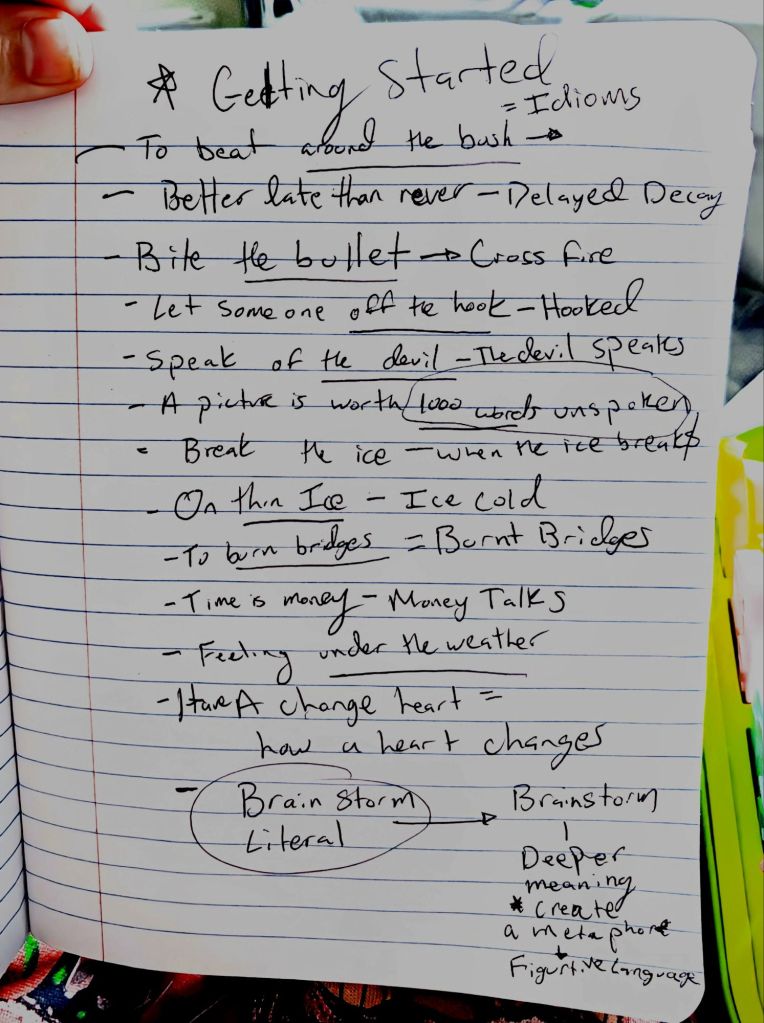
Go to Google and type in “a list of idioms”. Here are some that would be a great starting point:
*Burn the midnight oil – to work late into the night
*Bite the bullet – to face a difficult situation bravely
*Hit the nail on the head – to be exactly right
*Break the ice – to ease tension or start a conversation
*Spill the beans – to reveal a secret
*Once in a blue moon – very rarely
*Cost an arm and a leg – extremely expensive
*The ball is in your court – it’s your turn to act
*Under the weather – feeling sick or unwell
*Cut corners – to do something cheaply or carelessly
Step 2:
Go through the list of examples, and pick a few that speak to you. The idiom you choose will be the catalyst of the type of poem you want to write.
Step 3:
Once you have picked out an idiom, generate a poem title. There’s a lot of different ways to do this. You can take a few words from the phrase/ idiom. You can mix up the words, or you can use the idiom in its entirety. I will be showing you an example of what I did and how I did it.
Step 4:
Once you have the title picked out, think about different ways you can use metaphors, similes, analogies, or other figurative language that has to do with the title you created. Think of an experience, emotion, or situation that will relate to the specific title. For example, I will take the idiom “to burn a bridge” and from there, I was able to come up with a poem titled “burnt bridges”. The different themes or topics that can attach to that specific title would be: breakups, friendships lost, drifting apart, love lost, forgiveness or lack thereof.
Step 5:
Start writing the poem. Again, you are going to do your best to take a simple idiom and attach emotion to it by using figurative language. This is the part where you can be creative and really touch on the specific theme. You could write it in first person perspective using “I” to make the poem more personal. You can use a second person perspective using “you” to make the poem more general, or you can use a third person perspective to create distance from you and the work. There’s nothing wrong with mixing all of those perspectives together.
Step 6:
Start writing!
Here is the result:
BURNT BRIDGES
–
You can’t cross a burnt bridge.
Friendships turn to Sunken ships.
Love turns to hate. The time
it took to cross the bridge
went to waste. Your fiery words
struck a cord that has been
cut. I was never enough.
Now, there is a broken body
of water separating you and I.
My eyes fixate on the pouring rain
as the sky cries. Burnt bridges
can be rebuilt. It just takes time.
We must leave the matches behind.


 IN YOUR DREAMS PUBLISHING
Leave a comment